

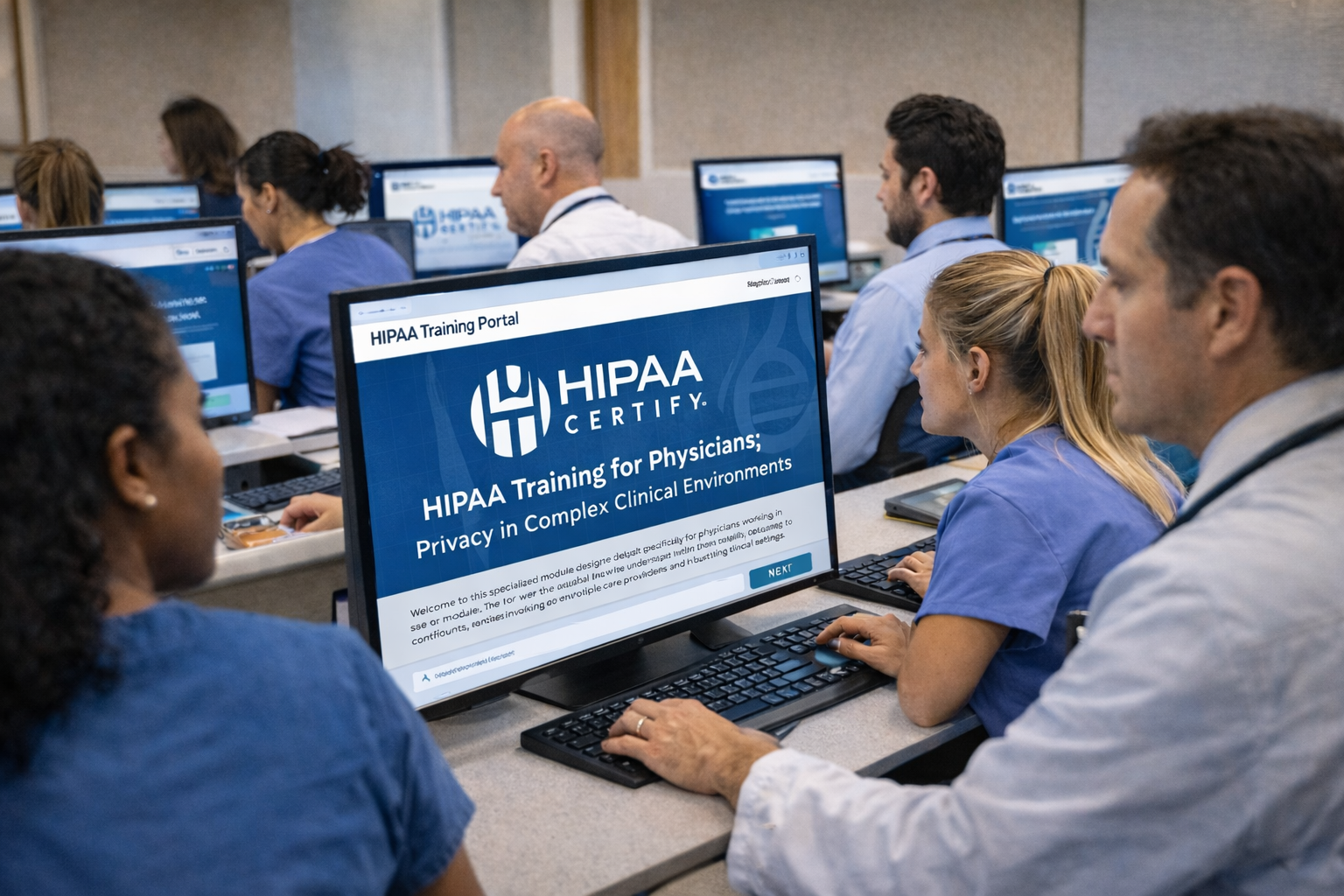
When Piedmont Regional Medical Center—a 250-bed community hospital in central Georgia—received notice of an upcoming compliance audit, their leadership team faced a sobering reality. Their HIPAA training records were scattered across multiple systems, nearly 40% of their workforce had no documented training from the past 12 months, and they had less than 45 days to get their house in order.
What happened next surprised everyone—including the compliance team. Using HIPAA Certify's automated training platform, Piedmont Regional trained their entire workforce of 1,847 employees in just 27 days. This is their story.
The Challenge: A Complex Workforce Spread Across Multiple Locations
Piedmont Regional isn't just a single hospital building. Like many mid-sized healthcare systems, their workforce is distributed across the main campus, four outpatient clinics, two urgent care centers, a rehabilitation facility, and a growing network of remote employees handling billing, coding, telehealth, and administrative functions.
"Our previous approach to HIPAA training was a disaster," admits Sarah Mitchell, Piedmont Regional's Chief Compliance Officer. "We'd schedule in-person sessions, but nurses on night shift couldn't attend. Our outpatient offices were always forgotten. And our remote workers? We'd email them a PDF and hope for the best. We had no way to prove anyone actually completed anything."
The workforce complexity extended beyond geography. Piedmont Regional employs registered nurses, LPNs, physicians, nurse practitioners, medical assistants, billing specialists, IT staff, environmental services, food services, security personnel, and administrative staff—each with different HIPAA training needs based on their level of PHI access.
"We needed a solution that could handle our complexity without requiring a dedicated person to manage it full-time," Mitchell explains. "With the audit looming, we didn't have months to implement a complicated system. We needed something that would work immediately."
Day One: Implementation That Actually Felt Simple
After evaluating three different HIPAA training platforms, Piedmont Regional selected HIPAA Certify based on three factors: simplicity of implementation, comprehensive reporting capabilities, and the responsiveness of their support team during the evaluation process.
"The other platforms we looked at wanted us to manually enter employee data or go through a lengthy integration process," recalls David Chen, Piedmont Regional's IT Director. "HIPAA Certify let us import our entire employee list directly from a CSV export of our HR system. We uploaded 1,847 employees in about ten minutes."
The employee import feature accepted standard fields including name, email, department, hire date, and critically—job codes. This last element proved essential for Piedmont Regional's training strategy.
"We have over 85 different job codes in our system," Chen explains. "HIPAA Certify let us import those codes and then map them to different training tracks. Clinical staff with direct patient contact got comprehensive training. Administrative staff with limited PHI access got a streamlined version. Environmental services got training focused on physical safeguards and what to do if they encounter patient information. The system handled all of this automatically based on job codes—we didn't have to manually assign training to 1,847 individual employees."
The Support Experience: L1, L2, and L3 Teams That Actually Respond
Implementation didn't go perfectly—no technology rollout ever does. But what distinguished the experience, according to Piedmont Regional's team, was how quickly issues got resolved.
"On day two, we discovered that about 200 employees had email addresses in our HR system that were no longer valid—mostly people who had changed from personal emails to hospital emails over the years," Mitchell recalls. "I submitted a support ticket expecting to wait days for a response. The L1 support team responded within two hours with a solution for bulk-updating email addresses."
A more complex issue arose during week two when Piedmont Regional wanted to customize the training completion certificate to include their hospital logo and specific compliance language required by their legal team.
"That request got escalated to the L2 team, who worked with us over a video call to understand exactly what we needed," says Chen. "They had the customized certificates ready within 48 hours. When we later needed a custom report format for our audit documentation, the L3 technical team built it for us. The tiered support structure meant our issues always reached someone who could actually solve them—we never felt stuck in a support queue talking to people reading from scripts."
Reaching Remote Employees and Outpatient Offices
One of Piedmont Regional's biggest concerns was reaching employees who never set foot in the main hospital building. Their four outpatient clinics operate semi-autonomously, each with their own office managers and workflows. The remote workforce—approximately 180 employees handling revenue cycle, telehealth support, and administrative functions from home—had historically been the hardest group to train and track.
"With HIPAA Certify, location became irrelevant," Mitchell explains. "Every employee received an email with their unique training link. They could complete the training from any device—their work computer, home laptop, even their phone during a lunch break. The platform tracked everything automatically."
The outpatient offices presented a different challenge. Staff at these locations often felt disconnected from main campus initiatives and had a history of low participation in compliance activities.
"We gave each office manager access to a dashboard showing their location's completion rates," says Mitchell. "Suddenly, compliance became visible at the local level. Office managers could see exactly who had completed training and who hadn't. They started following up with their own staff because they didn't want their location to be the one dragging down the numbers. We didn't have to chase anyone—the transparency created accountability."
The Results: 27 Days to Full Compliance
By day 27, Piedmont Regional had achieved something that previously seemed impossible: documented HIPAA training completion for 100% of their workforce. The numbers tell the story:
1,847 employees trained across all locations and departments. 85 job codes mapped to appropriate training tracks. 4 outpatient clinics with 100% completion. 180 remote employees trained and documented. Average training completion time of 47 minutes per employee. Zero support tickets unresolved for more than 24 hours throughout the implementation.
"When the auditors arrived, we handed them a comprehensive report showing every employee, their job code, the training they completed, their assessment scores, and their signed attestation confirming they understood their HIPAA responsibilities," Mitchell recalls. "The lead auditor actually commented that our documentation was among the most thorough they'd seen. Six months earlier, we couldn't have produced anything close to that."
The Simplicity Factor: Why It Actually Worked
Looking back, Mitchell attributes the success to one factor above all others: simplicity.
"We've implemented plenty of healthcare technology systems that promised to make our lives easier and ended up creating more work," she says. "HIPAA Certify was different. The employee import took minutes. The job code mapping was intuitive. The automated reminders meant we didn't have to manually chase people. The reporting gave us exactly what we needed without requiring us to build custom queries or export data to Excel for manipulation."
Chen echoes the sentiment from an IT perspective. "I allocated two weeks of my team's time for this implementation. We used about three days total, and most of that was just validating our data before import. The platform didn't require any special infrastructure, custom integrations, or ongoing technical maintenance. It just worked."
Beyond the Audit: Building Sustainable Compliance
The audit that triggered Piedmont Regional's urgent implementation has come and gone, but the hospital continues using HIPAA Certify for ongoing training management.
"New hires automatically receive their training assignment on day one," Mitchell explains. "We've integrated the employee import into our onboarding workflow, so when HR adds someone to the HRIS system, they're automatically added to HIPAA Certify with the correct job code and training assignment. Annual refresher training is scheduled automatically. I get weekly reports showing compliance status without having to request them."
The hospital has also expanded their use of the platform to include specialized training modules for specific departments—additional security awareness training for IT staff, enhanced privacy training for the health information management team, and role-specific modules for clinical areas with unique compliance requirements.
"HIPAA compliance used to be this looming anxiety—always worried about what we couldn't prove, what documentation we were missing, who hadn't been trained," Mitchell reflects. "Now it's just part of our operational rhythm. The system handles the complexity so we can focus on actually improving our privacy and security practices instead of chasing paperwork."
Lessons for Other Healthcare Organizations
For healthcare organizations facing similar challenges, Mitchell offers three pieces of advice:
First, don't wait for an audit or a breach to get serious about training documentation. The best time to implement a proper system is before you need it.
Second, prioritize simplicity over features. A platform with every bell and whistle is worthless if it's too complicated to implement quickly or requires dedicated staff to manage.
Third, evaluate support responsiveness before you commit. When issues arise—and they will—you need a vendor who responds in hours, not days.
"We went from compliance chaos to audit-ready in under 30 days," Mitchell concludes. "If a 250-bed hospital with 1,847 employees spread across multiple locations can do it, any healthcare organization can. You just need the right platform and the commitment to get it done."
Ready to transform your organization's HIPAA training program? Visit HIPAA Certify to see how their fully automated platform can help you achieve compliance faster than you thought possible.