

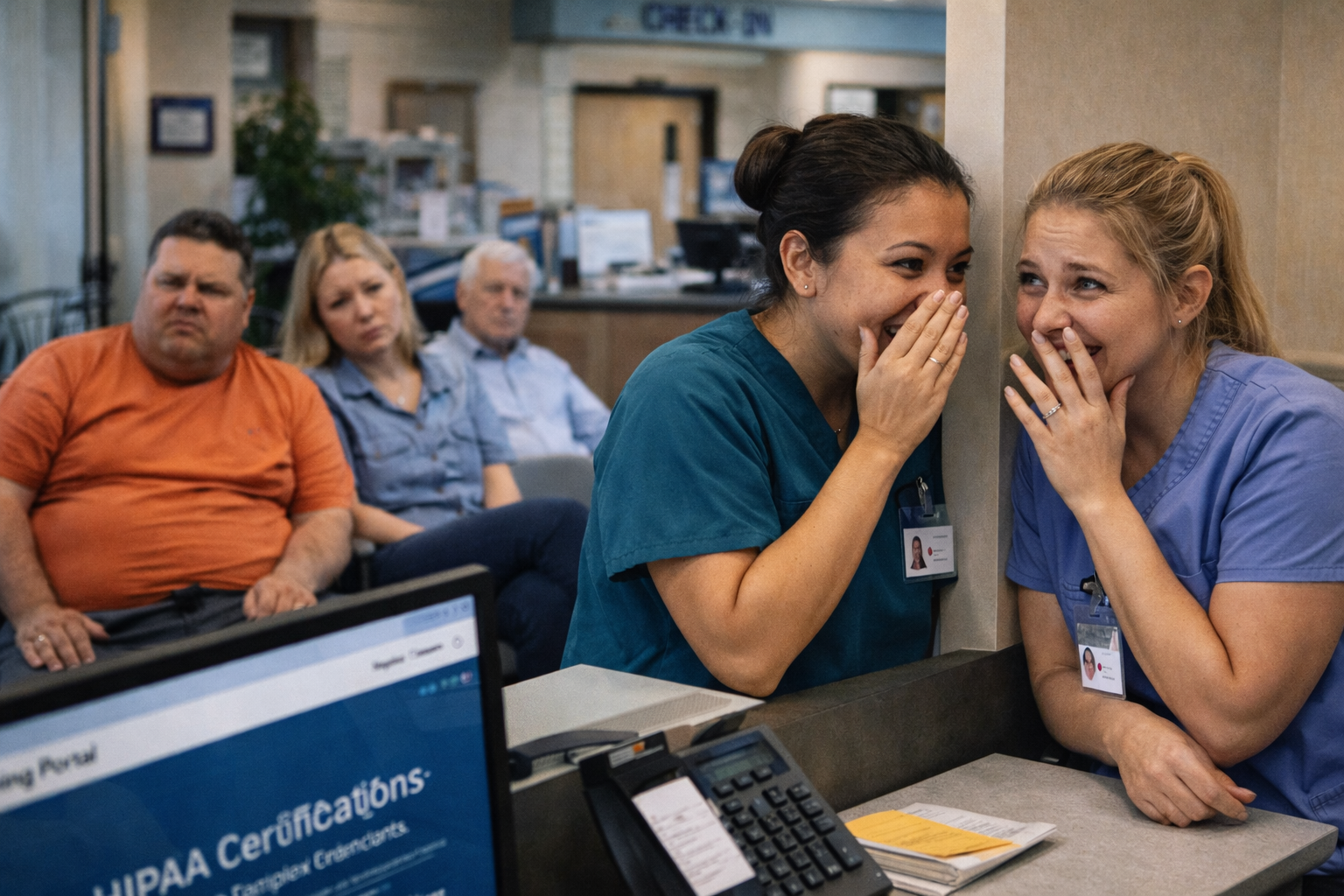
Last month, I accompanied a friend to a routine appointment at a specialist's office. I expected to spend thirty minutes scrolling through emails in the waiting room. What I didn't expect was to leave knowing the full names, medical conditions, insurance disputes, and prescription details of at least four other patients—none of whom I'd ever met.
As someone who has spent over two decades consulting on HIPAA compliance, I wanted to stand up and start handing out violation notices. Instead, I sat there—stunned—cataloging every breach I witnessed. By the time my friend's name was called, I had enough material for this entire blog post.
What I witnessed wasn't malicious. It wasn't even intentional. It was simply what happens when front desk staff aren't properly trained on HIPAA—and it's far more common than most healthcare organizations realize.
Everything I Overheard in 30 Minutes
Let me walk you through what happened. The waiting room was modest—maybe fifteen chairs arranged in a U-shape around a reception desk. The desk had no privacy barriers, no white noise machine, nothing to prevent conversations from carrying across the room.
Within the first five minutes, I watched a receptionist verify a patient's identity by reading their full name, date of birth, and the reason for their visit out loud. The patient had come for a follow-up on a chronic condition I won't name here—but everyone in that waiting room now knew about it.
A few minutes later, another patient approached the desk with an insurance question. The receptionist—trying to be helpful—pulled up her account and started explaining, at full volume, why her claim had been denied. The explanation included the specific procedure code, the diagnosis it was linked to, and the dollar amount the patient now owed. I learned that this woman had undergone a procedure I had no business knowing about and that her insurance considered it elective.
Then came the phone calls. One receptionist answered a call and repeated back the caller's name, date of birth, and medication refill request loudly enough for the entire room to hear. Another call involved explaining test results to what sounded like a family member—without first verifying whether that person was authorized to receive the information.
The final straw came when a receptionist called out to a colleague across the office: "Hey, did you fax that prior authorization for [patient's full name]? The one for the [specific medication]?"
I looked around the waiting room. A few people glanced up from their phones. Most didn't react at all. This was clearly normal.
Why Front Desk Staff Are Your Biggest HIPAA Risk
Here's what most healthcare organizations don't fully appreciate: your front desk and reception staff handle more patient information touchpoints in a single day than almost anyone else in your organization.
Think about everything that flows through the front desk: patient check-ins and identity verification, insurance card collection and verification, copay collection and billing questions, appointment scheduling and reason-for-visit documentation, phone calls about prescriptions, referrals, and test results, coordination with clinical staff about patient arrivals and needs, and handling of sensitive documents including intake forms and insurance authorizations.
Every single one of these interactions involves protected health information. Every single one presents an opportunity for an inadvertent disclosure. And unlike clinical staff—who typically interact with patients in private exam rooms—front desk staff do all of this in a semi-public environment where other patients can see and hear everything.
The math is simple: more PHI touchpoints plus a public-facing environment equals higher risk. Yet in my experience, front desk staff often receive less HIPAA training than clinical staff—if they receive any at all.
The Turnover Problem Nobody Talks About
There's another factor that makes front desk positions uniquely risky from a compliance perspective: turnover.
Front desk and receptionist positions in healthcare have some of the highest turnover rates in the industry. The work is demanding, the pay is often modest, and burnout is common. Many practices also rely heavily on temporary staffing agencies to fill gaps when regular employees are out.
What does this mean for HIPAA compliance? It means you might have someone handling sensitive patient information on their first day—someone who has never received any training on privacy requirements, minimum necessary standards, or proper verification procedures. It means your compliance training investment walks out the door every time an employee leaves. It means that temp worker covering for someone's vacation might have no idea that shouting a patient's medication across the office is a problem.
I've consulted with practices that have excellent HIPAA training for their physicians and nurses but essentially no onboarding process for front desk staff. The assumption seems to be that answering phones and checking patients in doesn't require the same level of compliance education. That assumption is dangerously wrong.
What Proper Training Actually Covers
Generic HIPAA training isn't enough for front desk staff. They need training that addresses the specific scenarios they encounter every day—scenarios that clinical staff might never face.
HIPAA training designed specifically for front desk and reception staff should cover topics like how to verify patient identity without broadcasting sensitive information to the waiting room, techniques for lowering voice volume and using privacy-conscious language, proper procedures for handling phone inquiries—including how to verify the caller's authorization to receive information, what to do when patients ask questions about their accounts in front of other patients, how to handle difficult situations like family members demanding information or patients becoming upset about billing issues, physical safeguards like positioning computer screens away from patient view and securing documents, and the minimum necessary standard—understanding that even authorized staff should only access the information needed for their specific task.
This isn't theoretical compliance education—it's practical, scenario-based training that prepares staff for the exact situations they'll encounter at the front desk.
The Temp Staff Question
"But what about temporary staff?" I hear this question constantly. "We can't put a temp through hours of training for a two-week assignment."
Here's my response: HIPAA doesn't care about employment status. The regulations require that all workforce members—including temporary staff, volunteers, and contractors—receive appropriate training before they access protected health information. "We didn't have time to train them" is not a defense OCR will accept.
The good news is that training doesn't have to take hours. Modern online training platforms can deliver focused, role-specific HIPAA education in under an hour. A temp can complete their front desk HIPAA training before their first shift, document their completion, and be prepared to handle patient information appropriately from day one.
Some staffing agencies now require their healthcare temps to complete HIPAA training before placement. If your agency doesn't, you should either require it as a condition of the assignment or build it into your onboarding process for all temporary workers.
Simple Changes That Make a Difference
Training is essential, but it's not the only solution. The waiting room I sat in that day had several environmental problems that made privacy violations almost inevitable.
Consider these relatively simple changes: install a white noise machine or play background music to prevent conversations from carrying, add privacy screens or barriers at the reception desk, create a separate area for sensitive conversations about billing or insurance, position the check-in area so that patients aren't standing directly in front of other waiting patients, use a sign-in system that doesn't display previous patients' names, train staff to invite patients to step aside for any conversation involving personal details, and implement a policy of spelling names rather than saying them aloud when verification is needed.
None of these changes require significant investment. Most just require awareness that the problem exists—awareness that comes from proper training.
What's Really at Stake
I want to be clear about what's at stake here. Yes, HIPAA violations can result in significant fines—up to $50,000 per incident, with annual maximums reaching $1.5 million per violation category. Yes, OCR investigates complaints, and patients who feel their privacy was violated can and do file them.
But the real cost isn't financial—it's human. The patients in that waiting room had their medical information exposed to strangers without their consent. Someone might have heard a diagnosis they weren't ready to share with anyone. Someone might have learned about a neighbor's health condition that's none of their business. Someone might have overheard financial information that could be used for fraud.
Privacy in healthcare isn't just a regulatory requirement—it's a fundamental patient right. People share their most sensitive information with healthcare providers because they trust that information will be protected. Every inadvertent disclosure chips away at that trust.
Take Action Today
If you manage a healthcare practice, I'm asking you to do something simple: sit in your own waiting room for thirty minutes. Don't announce yourself. Just sit there like a patient would and listen. Watch how your front desk staff handle check-ins, phone calls, and patient questions.
You might be surprised by what you hear. And if you are, that's your signal that training is overdue.
Visit HIPAA Certify to explore HIPAA training specifically designed for front desk and reception staff. The training is focused, practical, and can be completed quickly—even by temporary staff on their first day. Don't let your waiting room become someone else's blog post about everything they shouldn't have heard.