

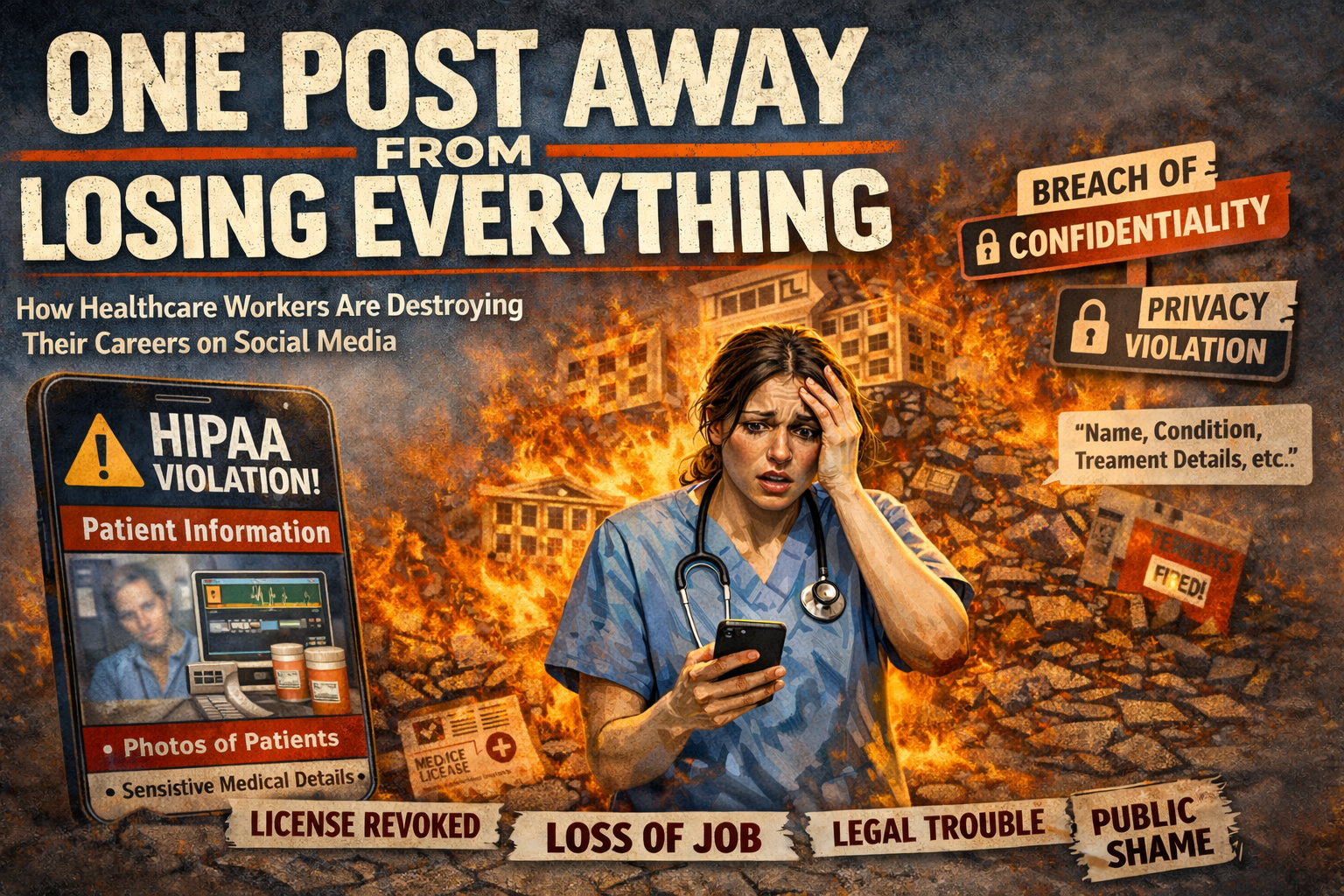
She thought the video was funny. Just a few seconds of a 93-year-old Alzheimer's patient, semi-naked, posted to Snapchat for her friends to see. What could go wrong?
Thirty days in jail. That's what went wrong.
Grace Riedlinger, a nursing assistant at Parkside Manor in Kenosha, Wisconsin, was fired, arrested, and sentenced for capturing an image of nudity without consent. The court commissioner called it "one of the most disgusting cases I've heard in a long time."
She's not alone. Across the country, healthcare workers are destroying their careers—sometimes in seconds—with social media posts they never imagined would cost them everything.
Jobs. Licenses. Freedom. Reputations built over decades. All gone because of a single post, photo, or video.
If you work in healthcare and use social media—and who doesn't?—this article might be the most important thing you read this year.
The TikTok That Ended a Nursing Career Before It Started
In May 2025, registered practical nurse Yazz Scott decided to go live on TikTok during a medication pass at work. She wasn't trying to expose patient information—or so she thought. She told viewers to "just relax" when they warned her she was violating HIPAA.
"I'm not showing any patient information, so just relax," she said on camera. "If y'all see some patient information, then just holler, but I'm not showing nothing."
But patient information was visible in the background. And during the livestream, she made a medication error—one that was now recorded and shared with the internet forever.
Scott had graduated from nursing school less than a year earlier. Now she was suspended, then terminated. The state Board of Nursing opened an investigation. Her career, barely begun, may already be over.
The video she deleted from her account? Copies are still circulating online. Once something is posted, it never truly disappears.
"Labor and Delivery Icks" Cost Four Nurses Their Jobs
In December 2022, four labor and delivery nurses at Emory University Hospital Midtown in Atlanta thought they'd participate in a popular TikTok trend. They filmed themselves sharing their "icks"—things that annoyed them about expecting mothers.
"My ick is when you come in for your induction talking about, 'Can I take a shower and eat?'" said one nurse.
"My ick is when you ask me how much the baby weighs and it's still in your hands," said another.
The 52-second video racked up over 100,000 views before it was deleted. Emory Healthcare responded swiftly: all four nurses were no longer employed. The hospital called the video "disrespectful and unprofessional" and stated it "falls far short of the values and standards we expect every member of our team to hold."
Women who had given birth at the hospital came forward to share their own negative experiences. One mother said the video "just brought back a lot of memories" of feeling uncared for during one of the most vulnerable experiences of her life.
The nurses didn't share any protected health information. They didn't identify any patients. But they demonstrated contempt for the people in their care—and broadcast that contempt to the world.
The Instagram Post That Cost a Nurse Her License
In 2015, a registered nurse in California posted photos of a patient's surgical wounds on Instagram. She didn't include the patient's name.
It didn't matter. The images showed identifying tattoos and the patient's room number—enough for someone who knew the patient to identify them.
The California Board of Registered Nursing revoked her license.
Not suspended. Revoked. Her nursing career was over—permanently—because of photos she thought were anonymous.
This is one of the most important lessons healthcare workers need to understand: a patient doesn't need to be named to be identified. A tattoo, a room number, a distinctive piece of jewelry, a mention of "that rare case" at a specific hospital—any of these can be enough for someone to connect the dots.
HIPAA Certify offers training specifically on this issue: Protecting Patients in the Camera Phone Era covers exactly how photos can inadvertently expose patient information—and how to protect yourself and your patients in a world where everyone has a camera in their pocket.
The Snapchat Scandal That Exposed an Industry-Wide Problem
In 2015, investigative journalists at ProPublica uncovered a disturbing pattern: nursing home workers across the country were taking photos and videos of elderly patients and sharing them on Snapchat. The investigation identified 35 separate incidents since 2012.
The content was horrifying: naked or semi-naked patients, patients using the toilet, patients being physically and verbally abused, patients who appeared to be deceased. At one facility, staff trained cognitively impaired patients to sing degrading song lyrics and filmed it for entertainment.
Many of the perpetrators assumed Snapchat's disappearing messages made them safe. They were catastrophically wrong.
At Gridley Healthcare in California, five workers were fired and prosecuted for elder abuse after sharing videos on Snapchat—including one of a nursing assistant "twerking" over a patient's head. In St. Charles, Illinois, two nursing assistants were filmed using a nylon strap to slap a 97-year-old dementia patient while she cried "Don't! Don't!" They pleaded guilty to battery.
One Indiana nursing assistant who posted a photo of a patient's naked backside served only three days in jail. In an interview, she tried to justify her actions: "They just blew everything out of proportion. It was just a picture of her butt."
This attitude—that digital content is somehow less real, less consequential—is exactly what gets healthcare workers in trouble. The course Snapchat at Work: The 'Disappearing' Myth & Phishing Risks addresses this dangerous misconception directly: nothing digital ever truly disappears, and assuming otherwise can cost you everything.
When Defending Your Reputation Destroys It: The Dentists Who Couldn't Stay Silent
Negative online reviews can feel like an attack. The urge to respond, to set the record straight, is powerful. But for healthcare providers, that urge has proven catastrophically expensive.
In 2019, Elite Dental Associates in Dallas responded to a patient's negative Yelp review by disclosing the patient's last name along with details of their health condition, treatment plan, insurance, and cost information. The Office for Civil Rights investigated and found this wasn't the first time the practice had disclosed patient information in review responses. The penalty: $10,000 and two years of federal monitoring.
In 2022, Dr. U. Phillip Igbinadolor responded to a patient's Google review by writing the patient's full name and details about their treatment. The response also included an insult, telling the patient to "continue with his manual work and not expose himself to ridicule." The civil penalty: $50,000.
That same year, New Vision Dental in California paid $23,000 for repeatedly disclosing patient information in Yelp review responses—including full names and insurance details of patients who had reviewed the practice using monikers specifically to remain anonymous.
Also in 2023, an Iowa dentist was sanctioned by the state dental board for disclosing a patient's name and treatment details in an online review response—putting their license at risk.
OCR Director Roger Severino put it bluntly: "Social media is not the place for providers to discuss a patient's care. Doctors and dentists must think carefully about patient privacy before responding to online reviews."
Here's what many providers don't understand: even saying "Thank you for coming in!" is a HIPAA violation because it confirms the reviewer is a patient. Even "Sorry you had a bad experience" confirms the treatment relationship. The only safe responses are completely generic—"Please give our office a call"—or no response at all.
The Reality Star Who Couldn't Separate Fame from Patient Care
Ashley Jacobs, a former cast member on the reality show Southern Charm, worked as a hospice nurse and home healthcare aide. Her fans encouraged her to post pictures with her patients. She acknowledged that doing so would violate HIPAA—and posted pictures anyway.
Then she sent a video to a fan through Instagram direct message that included one of her patients—a non-verbal pediatric patient who could not consent to being filmed.
The fan reported the video to the South Carolina Board of Nursing for violating HIPAA.
The lesson: the rules don't change based on how many followers you have. Patient privacy isn't something you can trade for engagement.
When Healthcare Becomes Content: The Growing Problem of Medical Social Media
Social media has created a culture where everything is content. Your lunch. Your workout. Your commute. Why not your job?
Because when your job involves other people's private health information, posting about it isn't just poor judgment—it's potentially illegal.
Nurse Kelly Morris posted TikTok videos joking about mistreating patients. She claimed they were comedy skits, that no one was harmed. Her employer at The Citadel at Winston Salem disagreed. She was suspended, and legal action followed.
A group of resident surgeons took pictures during operations—of body parts removed from patients, of patients still on the operating table. The images were uploaded online without consent. The surgeons faced investigation and potential severe consequences.
At Ballad Health in Tennessee, employees posted a photo of a patient undergoing surgery while surgeons wore a racing helmet, hashtagged "wear your helmet to work." The organization called the actions "unacceptable."
The impulse to share, to entertain, to be seen—it's human. But in healthcare, that impulse must be checked against the fundamental obligation to protect patient privacy and dignity.
The Penalties Are Real—And Getting Worse
If you think these are isolated incidents with minimal consequences, think again.
HIPAA civil penalties range from $100 to $50,000 per violation, with annual maximums up to $1.5 million. Criminal penalties can include fines up to $250,000 and imprisonment up to 10 years for willful violations involving personal gain.
But the legal penalties are often the least of it. Consider the real costs: immediate termination from your job, investigation by your state licensing board, potential loss of your professional license, permanent damage to your professional reputation, difficulty finding future employment in healthcare, civil lawsuits from patients whose privacy you violated, and a digital record that follows you forever.
Former nurse Tangela Lawson-Brown used patient information for tax fraud. She was sentenced to 60 months in federal prison and required to repay $141,790 to the IRS. That's an extreme case—but it illustrates how far the consequences can extend.
The "Innocent" Posts That Aren't Innocent
Most healthcare workers would never deliberately share patient information. But violations often happen through posts that seem completely harmless.
A selfie in the break room—with a patient chart visible in the background. A photo of your workspace—with a computer screen showing the EHR. A vague complaint about "that difficult patient"—combined with enough context clues that someone could identify who you mean. A funny story about "the weirdest case I've seen"—at a facility where such cases are rare. A comment on a news story—that reveals your involvement in someone's care.
The Texas Children's Hospital nurse who was fired in 2018 didn't name her patient. She simply posted to a Facebook group about treating a boy with measles—describing his symptoms and how difficult it was to watch him suffer. The post contained enough details that the patient could potentially be identified. She deleted her posts after being suspended, but it was too late.
Katie Duke, an ER nurse at New York-Presbyterian Hospital who gained fame on ABC's hospital documentary New York Med, was fired after posting an Instagram photo of a trauma room where she had just treated a man hit by a subway train. The caption: "Man vs. 6 train." The photo didn't show the patient—but the circumstances were specific enough to be identifying.
Protect Yourself Before It's Too Late
Every case in this article has something in common: the people involved thought it wouldn't happen to them.
They thought the post was harmless. They thought the video was private. They thought Snapchat messages disappear. They thought defending their reputation online was reasonable. They thought a photo without a patient's name was anonymous.
They were all wrong.
The only way to protect yourself is to understand exactly where the lines are—and to stay well inside them. That's why Social Media & PHI: Think Before You Post exists: to give healthcare workers the specific, practical knowledge they need to use social media without destroying their careers.
Because the question isn't whether you'll be tempted to post something from work. You will be. The question is whether you'll know—before you hit "share"—whether that post could cost you everything.
The nurses at Emory didn't think their TikTok would end their careers. The nursing assistant in Wisconsin didn't think her Snapchat would land her in jail. The California nurse didn't think her Instagram would cost her license.
Don't be the next cautionary tale. Get trained. Think before you post. And remember: in healthcare, what you share online doesn't just reflect on you—it reflects on every patient who trusted you with their most private information.