

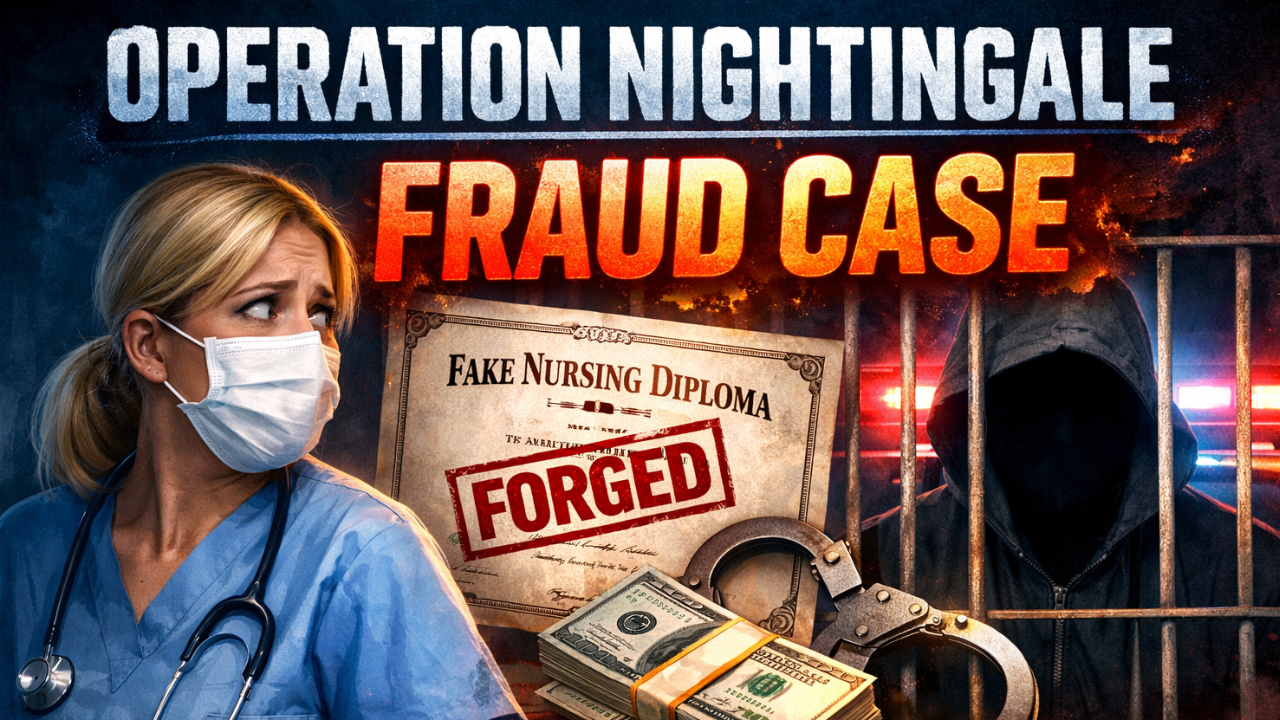
For about $15,000, you could skip nursing school entirely. No clinical rotations. No anatomy exams. No late nights studying pharmacology. Just a diploma, a transcript, and a clear path to sit for the NCLEX—the national nursing board exam that stands between aspiring nurses and a license to practice.
That was the deal offered by a network of Florida-based nursing schools between 2016 and 2021. And more than 7,600 people took it.
Many of them passed the exam. Many of them got licensed. Many of them got jobs—in hospitals, nursing homes, and clinics across the country. Some of them are still working today.
Welcome to Operation Nightingale—the largest nursing credential fraud scheme in American history.
What Was Operation Nightingale?
On January 25, 2023, the U.S. Department of Health and Human Services Office of Inspector General (HHS-OIG) announced a multi-state coordinated law enforcement action targeting individuals who had been selling fraudulent nursing credentials. The operation—named after Florence Nightingale, the founder of modern nursing—resulted in immediate search warrants executed in Delaware, New York, New Jersey, Texas, and Florida.
Twenty-five defendants were initially charged with wire fraud and conspiracy to commit wire fraud. The scheme was staggering in scope: three Florida nursing schools—Siena College in Broward County, Palm Beach School of Nursing, and Sacred Heart International Institute—had been issuing fake diplomas and transcripts to people who never completed the required coursework or clinical training.
The documents looked legitimate because, in a sense, they were. These schools had been accredited by the State of Florida to issue nursing credentials. The accreditation was real. The diplomas were real documents from real institutions. What wasn't real was the education behind them.
According to Department of Justice records, the scheme generated more than $100 million. By late 2023, 27 defendants had been convicted. Sentences ranged from probation to 78 months in federal prison, with forfeiture orders totaling millions of dollars.
How the Scheme Worked
The pathway to becoming a registered nurse or licensed practical nurse is demanding for good reason. Nursing programs require years of coursework in anatomy, physiology, pharmacology, and patient care. Clinical rotations put students in real healthcare settings under supervision, where they learn to administer medications, monitor vital signs, respond to emergencies, and communicate with patients and families.
The fraudulent schools bypassed all of it.
Recruiters and facilitators—some operating nursing exam prep centers in New York and New Jersey—connected aspiring nurses with the Florida schools. For approximately $15,000, buyers received official-looking diplomas and transcripts indicating they had completed nursing programs. These documents were then used to register for the NCLEX examination.
Here's the disturbing part: many of them passed.
The NCLEX is designed to test minimum competency for safe nursing practice. But it's a standardized test—and standardized tests can be studied for. Some buyers may have had healthcare experience in other capacities. Others may have used exam prep courses (sometimes offered by the same people selling the fake diplomas) to cram enough knowledge to pass.
Once they passed the exam and received state licensure, they were legally authorized to work as nurses. Employers had no reason to suspect anything was wrong—the licenses were real, issued by legitimate state boards.
The Investigation Expands: Phase II
Operation Nightingale didn't end with the 2023 arrests.
In September 2025, the HHS-OIG announced Phase II: twelve more defendants charged for their roles in selling fraudulent nursing diplomas and transcripts. The investigation revealed additional schools involved, including Carleen Health Institute and Med-Life Institute.
As of early 2026, more than 40 individuals have been charged in connection with the scheme. The FBI continues to work with state nursing boards nationwide to identify individuals who may have obtained licensure through fraudulent means.
The Fallout: State Boards Scramble to Respond
When Operation Nightingale became public, state nursing boards across the country faced an urgent question: how many of these 7,600 fake graduates had obtained licenses in their states?
The answer varied widely. The Texas Board of Nursing immediately began working with the FBI, NCSBN, and other regulatory bodies to identify affected licensees. The California Board of Registered Nursing launched its own investigation, posting updates and disciplinary actions to their website.
The Maryland Board of Nursing was notified of 287 nurses and applicants potentially connected to the scheme. By April 2025, they had completed their review: 205 individuals were cleared after demonstrating legitimate qualifications, but three had their licenses revoked, seven were referred for prosecution, three voluntarily surrendered their licenses, and twelve applicants withdrew their applications.
Connecticut reported at least 58 licenses revoked or surrendered as of June 2025. The Oregon State Board of Nursing identified approximately six active licensees and ten applicants potentially involved, taking action against several of them.
The National Practitioner Data Bank (NPDB) issued guidance to state boards on how to report Operation Nightingale-related disciplinary actions, including using specific codes for "Fraud, Deceit or Material Omission in Obtaining License or Credentials."
Why This Matters: The Patient Safety Question
The most troubling aspect of Operation Nightingale isn't the fraud itself—it's what the fraud enabled.
Nursing isn't a profession where you can fake it until you make it. Nurses administer medications with narrow margins between therapeutic doses and lethal ones. They monitor patients for subtle changes that indicate deterioration. They respond to codes and emergencies. They make clinical judgments that directly impact whether patients live or die.
The clinical training that fraudulent diploma buyers skipped isn't bureaucratic box-checking. It's where nursing students learn to recognize when a patient is going into shock. It's where they practice inserting IVs and catheters under supervision before doing it on real patients. It's where they learn the difference between a medication error that can be corrected and one that can't.
As HHS-OIG Special Agent Omar Pérez Aybar stated when announcing the investigation: "The alleged selling and purchasing of nursing diplomas and transcripts to willing but unqualified individuals is a crime that potentially endangers the health and safety of patients and insults the honorable profession of nursing."
To date, no state has publicly reported patient harm directly attributed to Operation Nightingale nurses. But the absence of reported harm doesn't mean harm didn't occur—it may simply mean it wasn't detected or connected to credential fraud.
The Systemic Failure: What Operation Nightingale Exposed
Operation Nightingale revealed a fundamental weakness in healthcare credentialing: the system assumes that accredited institutions are issuing legitimate credentials.
When an employer verifies a nursing license, they're checking that the license is valid and in good standing with the state board. They're not—and typically can't—verify that the education underlying that license was legitimate. State boards rely on nursing schools to accurately report who completed their programs. The NCLEX tests knowledge, not whether that knowledge was acquired through an accredited program.
The scheme exploited every gap in this chain of trust.
For healthcare employers, the lesson is clear: license verification alone isn't enough. Primary source verification of education—contacting institutions directly to confirm graduation—should be standard practice. Ongoing license monitoring should be implemented to catch status changes. And employers should be aware of high-risk institutions flagged by regulatory bodies.
The Ongoing Impact: Three Years Later
Three years after the initial announcement, Operation Nightingale continues to reshape healthcare credentialing.
State nursing boards have implemented enhanced verification procedures. The National Council of State Boards of Nursing (NCSBN) has issued fraud detection guidance for employers and educators. Healthcare facilities are revisiting their credentialing processes, recognizing that a valid license doesn't guarantee legitimate underlying education.
But investigations continue. As recently as September 2025, new individuals have been identified and charged. State boards are still working through backlogs of cases. Some nurses whose credentials are under review remain in practice while investigations proceed—due process requires evidence before licenses can be revoked.
The scheme also occurred during a period of acute nursing shortages, which created pressure to hire quickly and may have reduced scrutiny of credentials. That shortage hasn't abated—if anything, it's intensified. The tension between staffing needs and thorough credentialing remains unresolved.
What Healthcare Organizations Should Do Now
Operation Nightingale isn't just a law enforcement matter. It's a compliance and risk management issue for every healthcare organization that employs nurses.
At minimum, organizations should implement primary source verification of nursing education for all new hires, not just license verification. They should establish ongoing license monitoring through services like NCSBN's Nursys database. They should review current staff credentials against known fraudulent institutions. And they should train HR and compliance staff to recognize red flags in credential documentation.
The three Florida schools at the center of the original scheme are now closed. But the investigation has expanded to include additional institutions, and there's no guarantee similar schemes aren't operating elsewhere. Vigilance isn't optional.
The Bottom Line
Operation Nightingale exposed an uncomfortable truth: the systems we rely on to ensure healthcare workers are qualified have significant vulnerabilities. More than 7,600 fake nursing credentials entered the healthcare system. Thousands of those credential holders obtained licenses and jobs. State boards have revoked hundreds of licenses, but investigations continue years later.
For the nursing profession, the scandal is an insult to every nurse who earned their credentials through years of demanding education and clinical training. For patients, it's a reminder that the person at their bedside may not be who they claim to be. For healthcare organizations, it's a wake-up call about the limitations of current credentialing practices.
The investigation continues. The reforms are ongoing. And somewhere, right now, someone with a fraudulent nursing credential may still be working—because not all 7,600 have been found yet.