

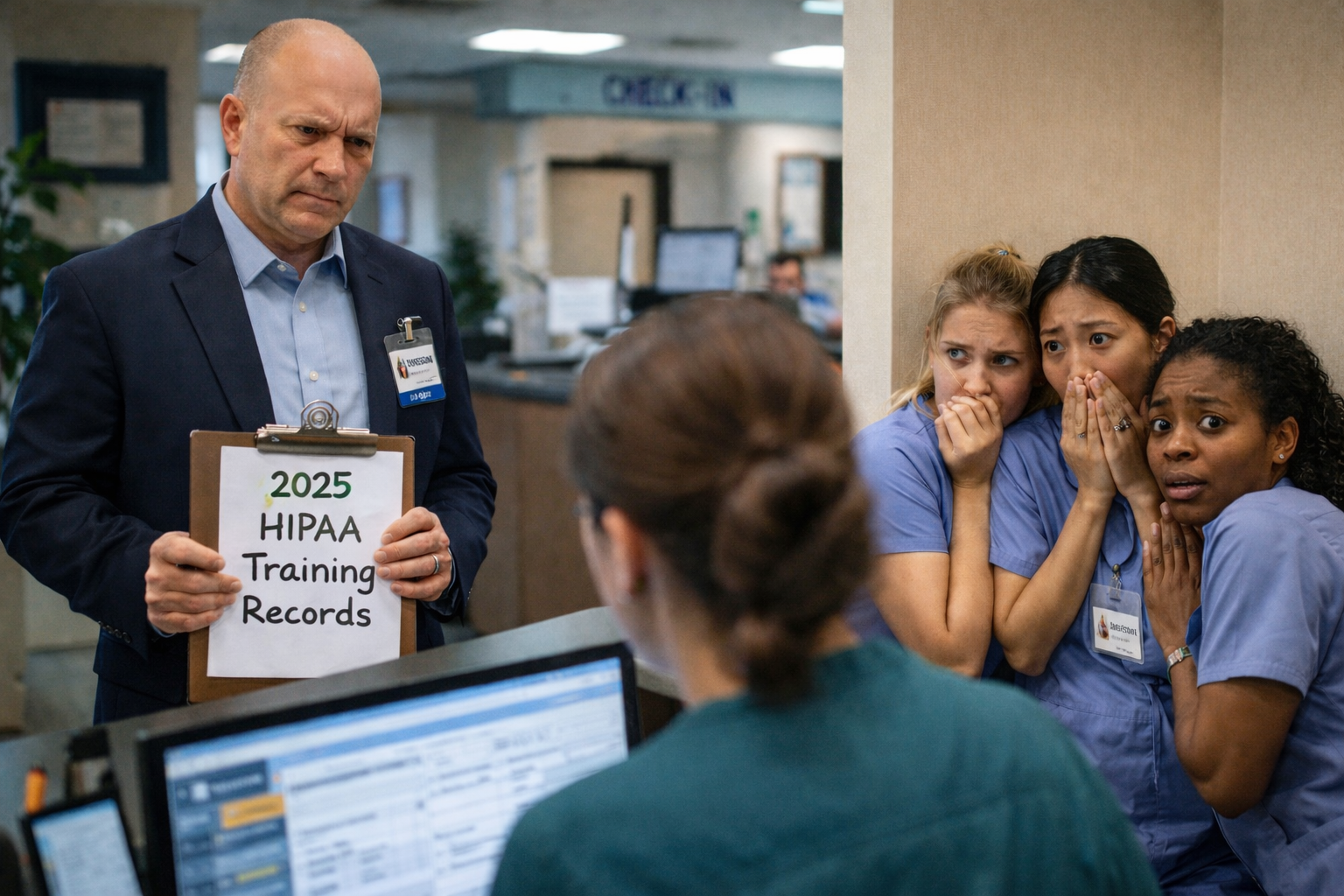
After consulting for over 2,500 healthcare organizations, they all had one major risk in common—no audit record or evidence of HIPAA training. It didn't matter if they were a 10-bed rural clinic or a 500-physician health system. When I asked to see their training documentation, I was met with the same awkward pause, the same shuffling through filing cabinets, and the same defeated admission: "We know we did the training... we just can't prove it."
That single gap—the inability to demonstrate compliance—has cost organizations millions of dollars in fines, triggered years of corrective action plans, and ended careers. And here's what frustrates me most: it's entirely preventable.
I've spent over 25 years in cybersecurity and compliance consulting, and I've seen the Office for Civil Rights (OCR) transform from an understaffed agency that rarely enforced penalties to an aggressive regulator that closed 22 investigations with financial penalties in 2024 alone. The rules of the game have changed, and organizations that don't adapt are finding themselves in OCR's crosshairs.
In this post, I'm going to share exactly what I've learned about staying off OCR's radar—and why training documentation is the foundation everything else builds upon.
Understanding How OCR Investigations Actually Work
Before we dive into prevention strategies, you need to understand how OCR operates. Most healthcare organizations have a fundamental misunderstanding about what triggers an investigation and what OCR looks for once they start digging.
OCR investigations typically begin one of three ways: a patient complaint, a breach report affecting 500 or more individuals, or increasingly, proactive compliance audits. Once an investigation opens, OCR doesn't just look at the specific incident—they conduct a comprehensive review of your entire HIPAA compliance program.
This is where organizations get blindsided. A single patient complaint about a privacy issue can snowball into a six-figure penalty when OCR discovers systemic compliance failures during their investigation. I've seen a $5,000 complaint turn into a $500,000 settlement because the organization couldn't demonstrate they had trained their workforce.
The first document OCR requests in nearly every investigation? Training records. They want to see who was trained, when they were trained, what topics were covered, and proof that employees acknowledged their understanding. If you can't produce this documentation within the requested timeframe—typically 30 days—you've already signaled to investigators that your compliance program has serious deficiencies.
The Training Documentation Crisis I See Everywhere
Let me paint a picture of what I encounter in my consulting work. I walk into an organization and ask the compliance officer to show me their HIPAA training documentation from the past six years (the HIPAA retention requirement). Here's what I typically find:
Sign-in sheets from in-person training sessions—some legible, some not, many missing entirely. Spreadsheets that someone started maintaining but abandoned after a few months. Email confirmations that "prove" training was assigned but don't confirm completion. A learning management system that was implemented three years ago but contains no records from before that time. Terminated employees with no training records whatsoever because "they're no longer with us."
The common thread? No centralized, auditable system that can produce a comprehensive training report on demand. And that's exactly what OCR expects you to have.
I remember one case vividly. A mid-sized hospital had experienced a phishing attack that exposed the records of 12,000 patients. During the OCR investigation, they were asked to produce training records for the employee who clicked the malicious link. The employee had been with the organization for four years. The hospital could only produce a single sign-in sheet from an orientation session four years prior—no annual refresher training, no security awareness training, nothing addressing phishing specifically.
The penalty wasn't just for the breach. It was for the systemic failure to maintain a training program. The final settlement exceeded $1.2 million.
What OCR Actually Requires for Training Compliance
The HIPAA Privacy Rule at 45 CFR § 164.530(b) requires covered entities to train all members of their workforce on policies and procedures necessary to carry out their functions. The Security Rule at 45 CFR § 164.308(a)(5) requires security awareness training for all workforce members, including management.
But here's what many organizations miss: the regulations also require documentation. Under 45 CFR § 164.530(j), covered entities must maintain training records for six years from the date of creation or the date when the policy was last in effect, whichever is later.
What should these records include? At minimum, you need the name of each workforce member trained, the date training was completed, the topics covered in the training, and acknowledgment that the employee understood their responsibilities. This acknowledgment—what I call an attestation—is crucial because it shifts the burden of responsibility.
When an employee signs an attestation confirming they completed training and understand HIPAA requirements, you have documented proof that the organization fulfilled its training obligations. If that employee later violates HIPAA, the organization can demonstrate it wasn't due to a failure to train—it was the employee's individual misconduct. That distinction can mean the difference between a warning letter and a seven-figure penalty.
The New Hire Training Gap That Creates Immediate Risk
One of the most critical—and most overlooked—compliance requirements involves new hire training. The HIPAA Privacy Rule requires that new workforce members receive training within a "reasonable period of time" after joining the organization. OCR has interpreted this to mean before the employee has access to protected health information.
Think about how most healthcare organizations actually onboard employees. Day one, the new hire gets their badge, their login credentials, and access to the EHR system. Somewhere in the stack of HR paperwork, there might be a HIPAA acknowledgment form. The actual training? That happens "when we get around to scheduling it"—which might be weeks or months later.
Every day that passes between granting PHI access and completing training is a day of non-compliance. Multiply that across dozens or hundreds of new hires per year, and you have a systemic violation pattern that OCR takes very seriously.
This is why I strongly recommend implementing onboarding HIPAA training as a mandatory prerequisite before any system access is provisioned. The training should be completed on day one—ideally before the employee even touches a computer with patient data. This approach eliminates the gap entirely and creates a clear documentation trail from the employee's first day.
Why Manual Training Processes Fail
I've consulted with organizations that insist their training program is adequate because they hold annual compliance meetings. They gather everyone in the conference room, run through a PowerPoint presentation, and pass around a sign-in sheet. Box checked, right?
Wrong. This approach fails for multiple reasons.
First, it's nearly impossible to schedule training that every employee can attend. Healthcare operates 24/7. Night shift nurses, weekend staff, PRN employees, and remote workers often get missed. When I audit these organizations, I typically find 15-30% of the workforce with no training records because they couldn't attend the scheduled sessions.
Second, sign-in sheets are terrible documentation. They prove someone was present in a room, not that they paid attention, understood the material, or can apply it to their work. OCR knows this, which is why they look for assessments and attestations in addition to attendance records.
Third, paper records get lost. Filing cabinets flood. Documents get misfiled. Employees take records with them when they leave. Six years of documentation retention becomes a logistical nightmare when you're managing physical paperwork.
Fourth, there's no way to quickly generate reports. When OCR sends a document request, you don't have months to compile records—you have weeks. If your training documentation is scattered across spreadsheets, filing cabinets, and email folders, you're going to struggle to respond comprehensively and accurately.
The Case for Automated Training Platforms
After seeing the same documentation failures hundreds of times, I started recommending that every healthcare organization—regardless of size—implement a fully automated HIPAA training platform. The return on investment isn't just about convenience; it's about survival.
A proper automated system handles training assignment, delivery, tracking, assessment, attestation, and reporting without human intervention. New hires automatically receive their training assignment. Completion status is tracked in real-time. Assessments verify comprehension. Digital attestations are captured and stored. Reports can be generated instantly.
HIPAA Certify is the platform I recommend to my clients because it was built specifically for this purpose. It's not a generic learning management system retrofitted for healthcare compliance—it's purpose-built for HIPAA training with all the documentation features that OCR expects to see.
The platform includes a HIPAA training attestation tool that captures the exact documentation OCR looks for during investigations. Each attestation includes the employee's name, the training completed, the date and time of completion, the topics covered, assessment scores, and a digital signature confirming understanding. These records are stored securely and can be exported instantly when needed for an audit or investigation.
Building a Culture of Compliance
Training documentation is foundational, but it's not sufficient on its own. Over my decades of consulting, I've observed that organizations with the best compliance posture share certain characteristics that go beyond checking regulatory boxes.
They treat compliance as continuous, not annual. HIPAA isn't a once-a-year training session—it's a daily practice. The best organizations supplement annual training with regular reminders, phishing simulations, policy updates, and ongoing education.
They make training role-specific. A billing specialist faces different HIPAA challenges than an ER nurse. Generic training that covers the basics but doesn't address role-specific scenarios leaves gaps that employees will stumble into.
They create psychological safety for reporting. Employees who fear punishment for making mistakes or asking questions will hide problems rather than report them. Organizations that encourage reporting, even of near-misses, catch small issues before they become big breaches.
They conduct regular risk assessments. The HIPAA Security Rule requires periodic risk analysis, and it's the most commonly cited violation in OCR enforcement actions. Organizations that proactively identify and address risks are far less likely to experience breaches—and far better positioned to defend themselves if they do.
The Risk Analysis Connection
Speaking of risk analysis, I need to address the elephant in the room. In 2025, OCR launched its HIPAA Risk Analysis Initiative, specifically targeting organizations that have failed to conduct adequate risk assessments. As of mid-2025, this initiative has already resulted in nine settlements with financial penalties.
Why the focus on risk analysis? Because it's the foundation of the entire HIPAA Security Rule. You can't implement appropriate safeguards if you haven't identified your risks. You can't prioritize your security investments if you don't know where your vulnerabilities lie. And you certainly can't demonstrate compliance if you can't show OCR a documented risk assessment.
Training and risk analysis are interconnected. Your risk assessment should identify training gaps as a potential vulnerability. Your training program should address the specific risks identified in your assessment. This cyclical relationship is what OCR expects to see in a mature compliance program.
What to Do If You're Starting From Zero
If you're reading this and realizing your organization has significant documentation gaps, don't panic—but do act urgently. Here's the remediation approach I recommend:
First, implement an automated training platform immediately. Get every current employee through comprehensive HIPAA training within the next 30 days. Yes, this is aggressive, but if OCR comes knocking tomorrow, you want to show recent, documented training for your entire workforce.
Second, establish a new hire training protocol. Make HIPAA training a prerequisite for system access, no exceptions. Use the new hire HIPAA security awareness training module from HIPAA Certify to ensure consistent onboarding across all new workforce members.
Third, gather whatever historical documentation you can find. Even incomplete records are better than nothing. Organize them chronologically and identify the gaps you'll need to acknowledge if asked.
Fourth, conduct a risk analysis if you haven't done one recently. Document your findings, create a remediation plan, and start addressing identified risks. This demonstrates to OCR that you're taking compliance seriously.
Fifth, document everything going forward. Every training completed, every policy updated, every risk identified and addressed. Build the audit trail that will protect you in the future.
The Cost of Inaction
Let me be blunt about the stakes. HIPAA penalties range from $100 to $50,000 per violation, with annual maximums up to $1.5 million per violation category. In cases of willful neglect, criminal penalties can include fines up to $250,000 and imprisonment up to 10 years.
But financial penalties are just the beginning. Organizations under OCR investigation face years of corrective action plans, regular audits, mandatory compliance reporting, and reputational damage that can affect patient trust and business relationships. I've seen healthcare organizations struggle for years to recover from the operational and financial burden of an OCR enforcement action.
Compare that to the cost of a proper training program. A fully automated HIPAA training platform costs a fraction of a single OCR penalty. The ROI isn't even close.
My Final Recommendation
After 25 years and over 2,500 healthcare organizations, my advice is simple: invest in training documentation like your organization depends on it—because it does.
Implement a fully automated HIPAA training platform that handles assignment, delivery, assessment, attestation, and reporting. Make training a prerequisite for PHI access. Capture digital attestations that prove comprehension and acknowledgment. Generate reports instantly for any audit or investigation. Retain records for the full six-year requirement.
The organizations that stay off OCR's radar aren't necessarily the ones that never have incidents—they're the ones that can demonstrate they did everything right. When something goes wrong, they can show comprehensive training records, documented policies, completed risk assessments, and a culture of compliance.
Don't wait for OCR to come asking for records you can't produce. Start building your documentation foundation today. Visit HIPAA Certify to explore how a fully automated HIPAA training platform can transform your compliance posture—and keep your organization off OCR's radar for good.