

Home health aide is one of the fastest-growing careers in healthcare—and for good reason. As America's population ages and more people choose to receive care at home rather than in institutional settings, demand for qualified home health aides continues to surge. The U.S. Bureau of Labor Statistics projects 17% job growth from 2024 to 2034—much faster than the average for all occupations—with approximately 765,800 openings expected each year over the next decade.
If you're considering a career as a home health aide, this guide will walk you through everything you need to know: education requirements, training programs, certification, where the jobs are, and—critically—how to protect both yourself and your patients when providing care in private homes.
What Does a Home Health Aide Do?
Home health aides provide hands-on care to people who need assistance with daily living activities in their own homes. Unlike personal care aides, home health aides often work under the supervision of nurses or other healthcare practitioners and may perform basic health-related tasks.
Typical duties include assisting clients with bathing, dressing, and personal hygiene; helping with mobility and transfers; monitoring and recording vital signs such as pulse, temperature, and respiration; assisting with prescribed exercises and physical therapy routines; administering medications under nurse supervision; preparing meals according to dietary requirements; performing light housekeeping and laundry; providing companionship and emotional support; documenting care provided and reporting changes in client condition; and coordinating with healthcare teams and family members.
Home health aides work with elderly clients, people recovering from surgery or illness, individuals with disabilities, and patients receiving hospice care. The work is physically demanding but deeply rewarding for those who want to make a meaningful difference in people's lives.
Education Requirements
The barrier to entry for home health aide work is relatively low compared to other healthcare careers, making it an excellent starting point for those interested in the medical field.
The minimum education requirement is typically a high school diploma or GED, though some positions may not require even this. What matters more than formal education is completing an approved home health aide training program—which we'll cover next.
For those who want to advance their careers, many home health aides later pursue additional education to become Certified Nursing Assistants (CNAs), Licensed Practical Nurses (LPNs), or Registered Nurses (RNs).
Training Programs and Where to Find Them
Home health aide training programs are offered by community colleges, vocational schools, home health agencies, and continuing education departments at universities across the country. The federal minimum standard requires 75 hours of classroom and clinical training, though many states require more.
Training programs typically cover personal care skills (bathing, grooming, dressing), basic nutrition and meal preparation, infection control and safety procedures, communication skills for working with clients and families, understanding the aging process and common health conditions, emergency response and first aid, documentation and reporting requirements, and legal and ethical responsibilities.
Many universities and community colleges offer accredited home health aide programs. Here are some options to consider:
The University of Houston offers online home health aide training through their career training division. The University of Texas at Arlington provides a similar program for Texas residents. On the East Coast, Molloy University offers a comprehensive certified home health aide program. The University of Central Florida and University of South Carolina Upstate offer online programs through their continuing education departments.
Community colleges also offer excellent programs. SUNY Rockland Community College in New York offers a 75-hour program with clinical experience. MiraCosta College in California provides training that meets state certification requirements. Onondaga Community College and Owens Community College in Ohio offer combined CNA/HHA programs that provide dual certification.
Certification and Licensing Requirements
Certification requirements vary significantly by state. Some states require home health aides to be licensed or certified, which typically involves completing an approved training program, passing a competency examination, completing a background check, and registering with a state health care worker registry.
If you plan to work for a home health agency that receives Medicare or Medicaid funding, federal regulations require that you complete at least 75 hours of training and pass a competency evaluation. Many employers also require CPR and first aid certification.
Check with your state's department of health to understand the specific requirements in your area before enrolling in a training program.
Where the Jobs Are: Cities with Highest Demand
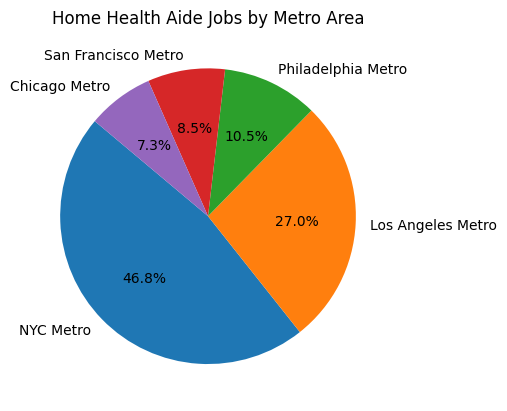
Not all job markets are created equal. According to the Bureau of Labor Statistics Occupational Employment and Wage Statistics, these metropolitan areas have the highest employment levels for home health and personal care aides:
The New York-Newark-Jersey City metro area leads the nation with over 556,000 home health aide positions. Los Angeles-Long Beach-Anaheim follows with approximately 321,000 jobs. Philadelphia-Camden-Wilmington employs around 124,600 aides, while San Francisco-Oakland-Hayward has roughly 100,500 positions. Chicago-Naperville-Elgin rounds out the top five with about 86,500 jobs.
At the state level, California employs the most home health aides with nearly 797,000 positions, followed by New York with 566,000, Texas with 312,000, Pennsylvania with 213,000, and Massachusetts with 114,000.
If you're looking for the highest-paying markets, Washington State leads with a mean annual wage of $42,000, followed by Oregon at $40,060 and Massachusetts at $38,550.
Salary Expectations
According to the Bureau of Labor Statistics, the median annual wage for home health and personal care aides was $34,900 in May 2024. The lowest 10 percent earned less than $25,600, while the highest 10 percent earned more than $44,190.
Wages vary significantly by setting and location. Aides working in residential facilities and continuing care communities typically earn more than those in individual and family services. Geographic location also plays a major role—home health aides in Washington State earn nearly double what those in Texas earn.
Protecting Patient Privacy: Why HIPAA Training Matters
Here's something that most home health aide training programs don't emphasize enough: as a home health aide, you have access to some of the most sensitive information about your patients. You know their diagnoses, medications, daily routines, family situations, and personal struggles. You see inside their homes. You hear their private conversations.
This level of access comes with serious responsibility—and legal obligations under HIPAA (the Health Insurance Portability and Accountability Act).
HIPAA training is essential for home health aides because it teaches you what protected health information (PHI) is and how to safeguard it, when and how you can share patient information with family members, supervisors, and other healthcare providers, how to document care properly without creating unnecessary risk, what to do if you witness or suspect a privacy breach, how to protect yourself legally when handling sensitive information, and the consequences of HIPAA violations for both you and your employer.
The Unique Privacy Challenges of Home Healthcare
Working in a patient's home creates privacy challenges you won't encounter in a hospital or clinic setting.
Family members and visitors may be present during care. Neighbors might ask questions about why you're there. You might use your personal phone to communicate with supervisors. Patient records might be stored in the home rather than in a secure facility. Other caregivers or household staff might have access to sensitive information.
Without proper training, it's easy to make mistakes that violate patient privacy—often without even realizing it. Something as simple as discussing your patient's condition with their neighbor or leaving a medication list visible on the kitchen counter can constitute a HIPAA violation.
Protecting Yourself and Your Patients
Proper HIPAA training doesn't just protect your patients—it protects you.
HIPAA violations can result in serious consequences: fines ranging from $100 to $50,000 per violation, potential criminal charges for willful violations, termination from your position, difficulty finding future employment in healthcare, and personal liability if a patient suffers harm due to a privacy breach.
When you understand HIPAA requirements, you can confidently navigate the gray areas that come up every day in home healthcare. You'll know exactly what you can and can't share, how to handle requests for information, and how to document your care in ways that are both thorough and compliant.
HIPAA Certify offers HIPAA Training for Home Health Care Agencies specifically designed for the unique challenges of providing care in patients' homes. The training addresses the real-world scenarios home health aides face every day—from handling family member questions to securing patient information in a home environment.
Step-by-Step: Your Path to Becoming a Home Health Aide
Here's a roadmap to get started in this rewarding career:
Step 1: Research your state's requirements. Before enrolling in any program, check with your state's department of health to understand licensing and certification requirements in your area.
Step 2: Complete a state-approved training program. Choose an accredited program from a community college, university, or vocational school. Make sure the program meets or exceeds your state's hour requirements.
Step 3: Pass your competency examination. Most states require you to demonstrate your skills through a written and/or practical exam.
Step 4: Obtain CPR and first aid certification. Most employers require this, and it's essential knowledge for working with vulnerable populations.
Step 5: Complete a background check. Working with vulnerable populations requires a clean background. Most states require criminal background checks.
Step 6: Complete HIPAA training. Protect yourself and your patients by understanding your privacy obligations. Visit HIPAA Certify to complete home health-specific HIPAA training.
Step 7: Register with your state's home care worker registry (if required). Some states maintain registries of certified home health aides.
Step 8: Apply for positions. Home health agencies, hospices, assisted living facilities, and private families all hire home health aides.
A Career That Makes a Difference
With nearly 766,000 job openings expected each year and growth rates far outpacing other industries, home health aide is one of the most in-demand careers in healthcare. For those who are compassionate, patient, and want to make a real difference in people's lives, it's a career that offers both meaningful work and job security.
The path to getting started is straightforward: complete an approved training program, get certified if your state requires it, and—critically—make sure you understand your HIPAA obligations so you can protect both your patients and yourself.
Ready to take the next step? Complete your HIPAA Training for Home Health Care today and show employers you're prepared to handle the responsibility that comes with this important role.